Is Art Morrison Frmae and Solid Rear Ened Better Than Rear Corvette Supension on C2
| Chevrolet Corvette (C2) | |
|---|---|
 1964 Chevrolet Corvette Convertible | |
| Overview | |
| Manufacturer | The Chevrolet Division of General Motors |
| Too called | Chevrolet Corvette Sting Ray |
| Product | August 1962–July 1967[1] [ii] |
| Model years | 1963–1967 |
| Assembly | U.s.: St. Louis, Missouri |
| Designer | Larry Shinoda (1959, 1960)[iii] Anatole Lapine[4]/[5] |
| Body and chassis | |
| Class | Sports motorcar |
| Body style |
|
| Layout | FMR layout |
| Related | Chetah Kellison J6 Panther Duntov LightWeight[6] Superformance Corvette Grand Sport[7] |
| Powertrain | |
| Engine |
|
| Transmission |
|
| Dimensions | |
| Wheelbase | 98.0 in (2,489 mm) (MY1963) [viii] |
| Length | 179.3 in (4,554 mm) |
| Width | 69.6 in (i,768 mm) |
| Tiptop | 49.6 in (1,260 mm) Coupe, convertible with hardtop, 49.viii in (1,265 mm) Convertible with soft meridian |
| Adjourn weight | three,362 lb (one,525 kg) |
| Chronology | |
| Predecessor | Chevrolet Corvette (C1) |
| Successor | Chevrolet Corvette (C3) |
The Chevrolet Corvette (C2) is the second generation of the Chevrolet Corvette sports auto, produced past the Chevrolet segmentation of Full general Motors for the 1963 through 1967 model years.[9]
History [edit]
Origin and development [edit]
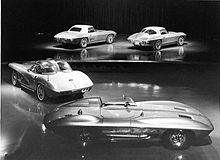
The 1959 Corvette Sting Ray concept and 1960 XP-700 show machine in the front and the 1963 Corvette convertible and fastback in the back.
The 1963 Sting Ray production automobile'southward lineage can exist traced to two separate GM projects: the Q-Corvette, and Bill Mitchell's racing Sting Ray. The Q-Corvette do of 1957 envisioned a smaller, more advanced Corvette as a coupe-only model, boasting a rear transaxle, independent rear suspension, and four-wheel disc brakes, with the rear brakes mounted inboard. Exterior styling was purposeful, with peaked fenders, a long nose, and a short, bobbed tail.
Meanwhile, Zora Arkus-Duntov and other GM engineers had become fascinated with mid and rear-engine designs. Duntov explored the mid/rear-engine layout with the lightweight, open-bicycle, single-seat CERV I concept of 1959. A rear-engined Corvette was briefly considered during 1958–threescore, progressing as far as a full-calibration mock-upward designed around the Corvair's entire rear-mounted power package, including its air-cooled flat-6, every bit an culling to the Corvette's usual water-cooled V8. By the fall of 1959, elements of the Q-Corvette and the Sting Ray Special racer would exist incorporated into experimental project XP-720, which was the design program that led straight to the production 1963 Corvette Sting Ray. The XP-720 sought to deliver improved rider accommodation, more luggage space, and superior ride and handling over previous Corvettes.
While Duntov was developing an innovative new chassis for the 1963 Corvette, designers were adapting and refining the basic wait of the racing Sting Ray for the product model. A fully functional space buck (a wooden mock-upward created to work out interior dimensions) was completed by early 1960, production coupe styling was locked up for the most part past April, and the interior, instrument panel included, was in place by Nov. Merely in the fall of 1960 did the designers turn their artistic attending to a new version of the traditional Corvette convertible and, still later, its detachable hardtop. For the first time in the Corvette's history, air current tunnel testing influenced the last shape, as did applied matters like interior space, windshield curvatures, and tooling limitations. Both trunk styles were extensively evaluated as product-fix 3/8-scale models at the Caltech wind tunnel.
The vehicle's inner structure received every bit much attention as the aerodynamics of its exterior. Fiberglass outer panels were retained, but the Sting Ray emerged with nearly twice as much steel support in its central structure as the 1958–62 Corvette. The resulting actress weight was balanced past a reduction in fiberglass thickness, and then the finished product actually weighed a bit less than the old roadster. Rider room was equally good as before despite the tighter wheelbase, and the reinforcing steel girder made the cockpit both stronger and safer.[10]
Design and applied science [edit]
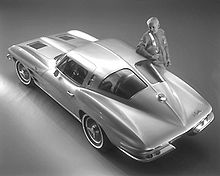
1963 Corvette Sting Ray Coupe
The first-ever production Corvette coupe sported a fastback body with a long hood and a raised windsplit that ran the length of the roof and continued down the dorsum on a colonnade that bisected the rear window into right and left halves. The split backlite is usually attributed to Mitchell, who claimed to have been inspired by the 57SC Bugatti "Atlantique" coupe. The feature actually predated both the C2 Corvette and Bob McLean's Q-Corvette, having been used by Harley Earl on both his Oldsmobile Golden Rocket evidence machine and his own more traditional pattern studies for the C2 Corvette, some of which had progressed to full-scale models.[xi] Earl's inspiration was said to accept been an Alfa Romeo coupe with a torso by Scaglione shown at the 1954 Turin Auto Bear witness. A similar design would be used by the third-generation Buick Riviera that ran from 1971 to 1973.
Quad headlamps were retained only newly subconscious – the first American machine so equipped since the 1942 DeSoto. The lamps were mounted in rotating housings that blended with the precipitous-edged front end when "closed". Hidden headlamps would be a feature of the Corvette until the C6 model debuted in 2005. Coupe doors were cut into the roof, which made entry/exit easier in such a low-slung airtight car. Faux vents were located in the hood and on the coupe'south rear pillars; functional ones had been intended merely were cancelled due to price considerations.
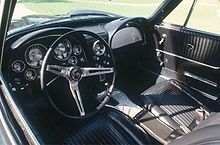
1963 Corvette Sting Ray interior
The Sting Ray's interior carried a re-interpretation of the twin-cowl Corvette dash motif used since 1958, just a more practical one incorporating a roomy glovebox, an improved heater, and the cowl-ventilation arrangement. A full ready of round gauges included a huge speedometer and tachometer. The control belfry center console returned, somewhat slimmer but now containing the clock and a vertically situated radio. Luggage space was improved as well, although due to the lack of an external trunklid, cargo had to be loaded behind the seats. The spare tire was located at the rear in a drop-down fiberglass housing beneath the gas tank (which now held 20 US gal (76 l; 17 imp gal) instead of 16 US gal (61 l; thirteen imp gal). The big round deck emblem was newly hinged to double as a fuel-filler flap, replacing the previous left-flank door.
Though not as obvious as the car's radical styling, the new chassis was just as important to the Sting Ray's success. Maneuverability was improved thank you to the faster recirculating brawl, or "Brawl-Race", steering, and a shorter wheelbase. The latter might ordinarily imply a choppier ride, but the altered weight distribution partly compensated for it. Less weight on the front wheels besides meant easier steering, and with some eighty additional pounds on the rear wheels, the Sting Ray offered improved traction. Stopping power improved, too. Iv-wheel cast-iron eleven-inch drum brakes remained standard but were at present wider, for an increase in effective braking area. Sintered-metallic linings, segmented for cooling, were once more optional. So were Al-Fin brake drums, which not only provided faster heat dissipation (and thus meliorate fade resistance) but less unsprung weight.[12] Ability assist was available with both brake packages. Evolutionary engineering changes included positive crankcase ventilation, a smaller flywheel, and an aluminum clutch housing. A more than efficient alternator replaced the old-fashioned generator.
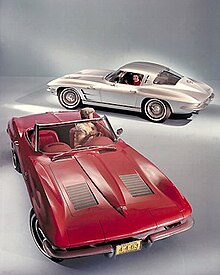
1963 Corvette Sting Ray Convertible & Coupe
The independent rear suspension created by Duntov was derived from the CERV I concept, and included a frame-mounted differential with U-jointed one-half-shafts tied together by a transverse leafage spring.[13] Prophylactic-cushioned struts carried the differential, which reduced ride harshness while improving tire adhesion, especially on rougher roads. The transverse jump was bolted to the rear of the differential case. A control arm extended laterally and slightly forward from each side of the example to a hub carrier, with a abaft radius rod mounted behind information technology. The one-half-shafts functioned like upper control artillery. The lower artillery controlled vertical wheel motion, while the abaft rods took care of fore/aft bicycle movement and transferred braking torque to the frame. Shock absorbers were conventional twin-tube units. Considerably lighter than the old solid axle, the new rear intermission assortment delivered a significant reduction in unsprung weight, which was important since the 1963 model would retain the previous generation'southward outboard rear brakes. The new model's front suspension would be much equally before, with unequal-length upper and lower A-arms on coil springs concentric with the shocks, plus a standard anti-roll bar. Steering remained the conventional recirculating-brawl steering design, but it was geared at a higher 19.vi:1 overall ratio (previously 21.0:one). Bolted to the frame rail at i end and to the relay rod at the other was a new hydraulic steering damper (essentially a shock absorber), which helped soak up bumps earlier they reached the steering wheel. What's more, hydraulically assisted steering would be offered equally optional equipment for the first fourth dimension on a Corvette – except on cars with the two most powerful engines – and offer a faster 17.1:ane ratio, which reduced lock-to-lock turns from 3.4 to only 2.9.
Drivetrains were carried over from the previous generation, comprising four 327 cu in (five,360 cc) small block V8s, three transmissions, and vi axle ratios. Carbureted engines came in 250 hp (186 kW), 300 hp (224 kW), and 340 hp (254 kW) versions. As before, the base and optional units employed hydraulic lifters, a balmy camshaft, forged-steel crankshaft, 10.5:1 compression, unmarried-point distributor, and dual exhausts. The 300-bhp engine produced its extra power via a larger four-barrel carburetor (Carter AFB instead of the 250'south Carter WCFB), plus larger intake valves and exhaust manifold. Once again topping the operation chart was a 360 hp (268 kW) fuel-injected V8, bachelor for an extra $430.xl. The motorcar's standard transmission remained the familiar three-speed manual, though the preferred gearbox connected to be the Borg-Warner manual iv-speed, irresolute over to the Muncie M20 during the 1963 model year, delivered with wide-ratio gears when teamed with the base and 300-bhp engines, and close-ratio gearing with the height two powerplants. Standard axle ratio for the three-speed manual or 2-speed Powerglide automated was 3.36:one. The four-speed gearbox came with a 3.70:ane terminal drive, but 3.08:1, 3.55:1, iv.xi:1, and four.56:1 gearsets were available. The concluding was quite rare in product, however.[10]

1963 Corvette with dissever rear window
Corvette's designers and engineers – Ed Cole, Duntov, Mitchell, and others – knew that after 10 years in its bones form, albeit much improved, information technology was time to motion on. Past decade's end, the mechanism would exist put into movement to way a fitting successor to debut for the 1963 model year. After years of tinkering with the basic parcel, Mitchell and his crew would finally break the mold of Harley Earl'due south original blueprint once and for all. He would dub the Corvette'south 2d generation "Sting Ray" after the before race car of the same name. The C2 was designed past Larry Shinoda (Pete Brock was also instrumental on the C2) nether the direction of GM master stylist Beak Mitchell. Inspiration was drawn from several sources: the gimmicky Jaguar E-Type, 1 of which Mitchell owned and enjoyed driving frequently; the radical Sting Ray Racer Mitchell designed in 1959 as Chevrolet no longer participated in factory racing; and a Mako shark Mitchell caught while deep-sea fishing. Duntov disliked the split rear window (which as well raised safety concerns due to reduced visibility)[xiv] and information technology was discontinued in 1964, as were the false hood vents.
Model year changes [edit]
1963 [edit]
The 1963 Corvette Sting Ray not only had a new design, simply as well newfound handling prowess. The Sting Ray was as well a somewhat lighter Corvette, then acceleration improved despite unchanged horsepower. For the 1963 model year, 21,513 units would exist congenital, which was up 50 pct from the tape-setting 1962 version. Production was divided almost evenly between the convertible and the new coupe – ten,919 and ten,594, respectively – and more than half the convertibles were ordered with the optional lift-off hardtop. Nevertheless, the coupe wouldn't sell as well again throughout the Sting Ray years. The airtight Corvette did non outsell the open one until 1969, by which time the coupe came with a T-tiptop featuring removable roof panels.[15] Equipment installations for 1963 began reflecting the market's need for more civility in sporting cars. The ability brake option went into 15 percent of production, power steering into 12 per centum. On the other manus, only 278 buyers specified the $421.fourscore air conditioning; leather upholstery – a mere $80.70 – was ordered on just 1,114 cars. The cast aluminum knock-off wheels, manufactured for Chevy by Kelsey-Hayes, price $322.80 a set, but few buyers checked off that option. However, nearly 18,000 Sting Rays left St. Louis with the four-speed manual gearbox – improve than four out of every v.[xvi]
All 1963 cars had 327cid engines, which made 250 hp standard, with optional variants that fabricated 300 hp, 340 hp and 360 hp. The about powerful engine was the Rochester fuel injected engine. Options available on the C2 included AM-FM radio (mid 1963), air conditioning, and leather upholstery. Also available for the first time ever on a Corvette was a special performance equipment package the RPO Z06, for $i,818.45. These Corvettes came to exist known as the "Big Tanks" because the package initially had a 36.v-US-gallon (138 l; 30.4 imp gal) gas tank versus the standard 20-gallon for races such as Sebring and Daytona. At first, the package was but available on coupes because the oversized tank would non fit in the convertible.
In 1963 only 199 Z06 Corvettes were produced, usually reserved for racing, and of the 199 a total of six were specifically created for Le Mans racing by Chevrolet. One of the six 1963 Z06 Sting Ray'due south was built tardily in 1962 to race at Riverside on thirteen October 1962.[17] They were destined to compete in a different sort of race for sports cars, a NASCAR sanctioned event on the famous Daytona Oval, the Daytona 250 – American Claiming Loving cup. This meant the cars needed to be prepared to a different set of rules, the aforementioned every bit those for the large Chiliad National stock cars. The chassis was modified extensively and an experimental 427 cu in (7,000 cc) engine installed.[xviii] The motorcar was lightened in every way possible and weighed only over 2,800 lb (1,300 kg). Further prep was done past Mickey Thompson. Among other changes, Thompson replaced the fiberglass Z06 "Big Tank" with an even larger l US gal (189.3 l; 41.half dozen imp gal) metallic tank.[19] Driven by Junior Johnson, plagued past rain in the race, substitute driver Baton Krause finished third behind Paul Goldsmith's Pontiac Tempest and A. J. Foyt in some other Corvette.[18] [20]
New for the 1963 model twelvemonth was an optional electronic ignition, the breakerless magnetic pulse-triggered Delcotronic, beginning offered by Pontiac on some 1963 models.[21]
1964 [edit]

1964 Corvette Sting Ray Coupe
For 1964 Chevrolet fabricated merely evolutionary changes to the Corvette. Besides the coupe's courage window, the two simulated air intakes were eliminated from the hood, though their indentations remained. Also, the decorative air-frazzle vent on the coupe's rear pillar was made functional, but only on the left side. The car's rocker-console trim lost some of its ribs and gained black pigment betwixt those ribs that remained; bicycle covers were simplified; and the fuel filler/deck emblem gained concentric circles around its crossed-flags insignia. Within, the original color-keyed steering wheel rim was at present done in fake walnut.
A few break refinements were made for 1964. The front coil springs were changed from constant-rate to progressive or variable-rate and were more tightly wound at the top, while foliage thickness of the rear transverse spring was also altered thus providing a more comfy ride with no sacrifice in handling. Stupor absorbers were reworked toward the aforementioned finish. The 1964 Corvette arrived with a new standard shock containing inside its fluid reservoir a pocket-sized bag of Freon gas that absorbed heat. Chevy added more audio insulation and revised body and transmission mounts for the 1964 Corvette. It also fitted additional bushings to quiet the shift linkage and placed a new boot around the lever. The event was a more than livable car for everyday transportation.
Drivetrain choices remained basically equally before but the high-performance pair received several noteworthy improvements. The solid-lifter unit was driven with a high-lift, long-duration camshaft to produce 365 hp (272 kW) and breathed through a large four-butt Holley carburetor instead of the base of operations engine's Carter unit of measurement. The fuel injected engine also gained 15 horsepower (11 kilowatts), bringing its total to 375 hp (280 kW), only at a and then-hefty $538.00. Although transmission options remained ostensibly the same for 1964, the ii Borg-Warner T-10 four-speeds gave way to a similar pair of gearboxes built at GM's Muncie, Indiana, transmission facility. Originally a Chevy design, information technology had an aluminum instance like the Borg-Warner box but came with stronger synchronizers and wider ratios for ameliorate immovability and drivability. If enthusiast publications liked the first Sting Ray, they loved the 1964, though some writers noted the convertible'due south tendency to rattle and milkshake on rough roads. Sales of the 1964 Sting Ray reached 22,229 -— another new Corvette record, if up only a fiddling from banner-year 1963. Coupe volume dropped to 8304 units, simply convertible sales more than compensated, rising to thirteen,925.[sixteen] [15]
1965 [edit]

1965 Corvette Sting Ray Convertible
For its tertiary season, the 1965 Corvette Sting Ray further cleaned up style-wise and was muscled upwardly with the addition of an all-new braking organisation and larger ability plants. 1965 styling alterations were subtle, bars to a smoothed-out hood now devoid of scoop indentations, a trio of working vertical exhaust vents in the front fenders that replaced the previous nonfunctional horizontal "speedlines," restyled bike covers and rocker-console moldings, and minor interior trim revisions. The 1965 Corvette Sting Ray became ferocious with the mid-twelvemonth debut of the "Large-Block" 396 cu in (6,490 cc) engine producing 425 hp (317 kW). Ultimately, this spelled the finish for the Rochester fuel injection organization, as the carbureted 396ci/425hp option cost $292.70 to the fuel injected 327ci/375hp's $538.00. Few buyers could justify $245 more for fifty hp (37 kW) less, even if the FI cars offered optional bigger brakes not available on carbureted models.[22] : 77 After simply 771 fuel injected cars were built in 1965, Chevrolet discontinued the option. It would be 18 years until it returned.
1965 also added another 350 hp modest block engine (Option L79) which used hydraulic rather than solid lifters, a milder camshaft and a modestly redesigned smaller oil pan.[23] Otherwise, the 350 hp engine was cosmetically and mechanically identical to the 365 hp engine (Option L76) solid lifter engine. The smaller oil pan allowed this high output small-scale block 350hp engine to be ordered with optional Ability Steering for the first fourth dimension amongst the optional stable of higher output small block engines. Power steering was previously only available with the lower 250 hp and 300 hp engines.
Four-bicycle disc brakes were too introduced in 1965. The brakes had a four-piston design with 2-piece calipers and cooling fins for the rotors. Pads were in frequent contact with the rotors, simply the resulting drag was negligible and did not affect fuel economic system. Further, the light touching kept the rotors clean and did not diminish pad life, which was, in fact, quite high: a projected 57,000 mi (92,000 km) for the front brakes and about twice that distance for the rear binders. Total swept surface area for the new system was 461 sq in (ii,970 cm2), a notable accelerate on the 328 sq in (2,120 cm2) of the previous all-drum arrangement. Per pending federal regulation, there was as well a dual primary cylinder with split fluid reservoirs (only on models with power brakes for 1965)[24] for the front and rear lines. Road testers rightly applauded the all-disc brakes. Testers plant that repeated stops from 100 mph (160 km/h) produced no deterioration in braking efficiency, and even the well-nigh sudden stops were rock-stable. The drum brakes remained available, however, as a $64.50 credit option, but simply 316 of the 23,562 Corvettes congenital that year came with drums.[sixteen] [15] A side exhaust system appeared every bit an option every bit did a scope steering wheel. Also available were blend spinner rims, at Usa$322 a fix.[22] : 77
1966 [edit]

1966 Corvette Sting Ray Convertible
For the 1966 Corvette, the big-block V8 came in 2 forms: 390 hp (290 kW) on x.25:1 compression, and 425 bhp via 11:i pinch, larger intake valves, a bigger Holley four-barrel carburetor on an aluminum manifold, mechanical lifters, and four- instead of two-hole chief bearing caps. Though it had no more than horsepower than the previous high-compression 396, the 427-cubic-inch (6,993 cc), 425 hp (317 kW) V8 packed a lot more torque – 460 lb⋅ft (624 Due north⋅m) vs. 415 lb⋅ft (563 North⋅m). In the 1960s engine outputs were at times deliberately understated. This happened for two reasons; to placate nervous insurance companies, and to allow the cars to authorize for lower NHRA brackets based on horsepower and weight.[25] Estimates of up to 450 hp (336 kW) for the 427 have been suggested as being closer to the truth. Conversely, power ratings in the sixties were done in SAE Gross Horsepower, which is measured on an engine without accessories or air filter or restrictive stock exhaust manifold, invariably giving a significantly higher rating than the engine actually produces when installed in the car.[26] SAE Net Horsepower is measured with all accessories, air filters and factory exhaust arrangement in place; this is the standard that all United states of america auto engines accept been rated at since 1972. With big-block V8s being the guild of the day, there was less demand for the 327, so small-block offerings were cut from v to two for 1966, and only the basic 300- and 350-bhp versions were retained. Both required premium fuel on pinch ratios well over 10.0:1, and they didn't have the rocket-similar thrust of the 427s, but their operation was impressive all the aforementioned. As before, both could be teamed with the Powerglide automatic, the standard three-speed manual, or either four-speed pick.
The 1966 model's frontal appearance was mildly altered with an eggcrate grille insert to supersede the previous horizontal confined, and the coupe lost its roof-mounted extractor vents, which had proven inefficient. Corvettes besides received an emblem in the corner of the hood for 1966. Head rests were a new option, one of the rarest options was the Cerise/Ruddy Automatic pick with power windows and air workout from manufactory which records show product numbered only 7 convertibles and 33 coupes. This relative lack of alter reflected plans to bring out an all-new Corvette for 1967. Information technology certainly did not reflect a autumn-off in the car's popularity, nonetheless. In fact, 1966 would prove another record-busting year, with volume rising to 27,720 units, up some 4,200 over 1965s sales.[16] [27]
1967 [edit]
The 1967 Corvette Sting Ray was the concluding Corvette of the second generation, and v years of refinements made it the all-time of the line. Although information technology was meant to exist a redesign year, its intended successor the C3 was plant to have some undesirable aerodynamic traits. Duntov demanded more time in the wind tunnel to devise fixes before it went into production.
Changes were again modest: Five smaller front end fender vents replaced the three larger ones, and flat-finish rockers sans ribbing conferred a lower, less chunky advent. New was a unmarried backup low-cal, mounted above the license plate. The previous models' wheel covers gave manner to slotted vi-inch Rally wheels with chrome beauty rings and lug nuts curtained backside chrome caps. Interior alterations were modest and included revised upholstery, and the handbrake moved from beneath the nuance to betwixt the seats. The convertible'southward optional hardtop was offered with a black vinyl comprehend, which was a fad amongst all cars at the time.
The 427 was available with a 1282 ft³/min (605 50/s) Rochester 3X2-butt carburetors arrangement, which the factory chosen Tri-Ability producing 435 bhp (441 PS; 324 kW) at 5800 rpm and 460 lb⋅ft (624 Northward⋅thou) at 4000 rpm of torque.[28] The ultimate Corvette engine for 1967 was coded L88, even wilder than the L89, and was as close to a pure racing engine every bit Chevy had ever offered in regular production. Too the lightweight heads and bigger ports, it came with an fifty-fifty hotter camshaft, stratospheric 12.5:1 compression, an aluminum radiator, small-bore flywheel, and a single huge Holley four-butt carburetor. Although the manufacturing plant advertised L88 rating was 430 bhp at 4600 rpm, the truthful rating was said to exist most 560 bhp at 6400 rpm. The very high compression ratio required 103-octane racing fuel, which was available only at select service stations. Clearly this was not an engine for the coincidental motorist. When the L88 was ordered, Chevy made several individual options mandatory, including Positraction, the transistorized ignition, heavy-duty suspension, and ability brakes, as well equally RPO C48, which deleted the normal radio and heater to cut down on weight and discourage the car's employ on the street. Equally costly as it was powerful – at an additional $1,500 over the base of operations $iv,240.75 toll – the L88 engine and required options were sold to a mere 20 buyers that year. With potential buyers anticipating the car's overdue redesign, sales for the Sting Ray's final year totaled 22,940, down over 5,000 units from 1966 results. Meanwhile, Chevrolet readied its third-generation Corvette for the 1968 model year.[16] [29]
Engines [edit]
| Engine | Year | Ability |
|---|---|---|
| 327 in³ Small-Cake V8 | 1963–1965 | 250 hp (186 kW) |
| 1963–1967 | 300 hp (224 kW) | |
| 1963 | 340 hp (254 kW) | |
| 1965–1967 | 350 hp (254 kW) | |
| 1964–1965 | 365 hp (272 kW) | |
| 327 in³ Modest-Block FI V8 | 1963 | 360 hp (268 kW) |
| 1964–1965 | 375 hp (280 kW) | |
| 396 in³ Large-Block V8 | 1965 | 425 hp (317 kW) |
| 427 in³ Big-Cake V8 | 1966–1967 | 390 hp (291 kW) |
| 1966 | 425 hp (317 kW) | |
| 427 in³ Big-Block Tri-Power V8 | 1967 | 400 hp (298 kW) |
| 1967 | 435 hp (324 kW) |
Reviews [edit]
The Sting Ray was lauded in the automotive printing almost unanimously for its handling, road adhesion, and sheer power.
Car Life magazine bestowed its annual Honour for Engineering science Excellence on the 1963 Sting Ray. Chevy'southward small-block V8 – the virtually consequent component of past Corvette performance – was rated past the vitrify books to be fifty-fifty ameliorate in the Sting Ray. The 1963 was noted to have an edge over past models in both traction and handling considering the new independent rear suspension reduced wheel spin compared to the live-axle cars.
Motor Tendency tested a 4-speed fuel injected version with three.70:1 axle. They reported a 0–lx mph in 5.viii seconds and a xiv.5-second standing quarter-mile at 102 mph. The magazine also recorded better than 18 miles per gallon at legal highway speeds and 14.1 mpg overall.
Motor Trend timed a 1964 fuel-injected four-speed coupe with the iv.11:1 rear axle, aluminum knock-off wheels (perfected at final and available from the manufactory), the sintered-metallic brakes, and Positraction through the quarter-mile in fourteen.2 seconds at 100 mph and the 0 to sixty mph in 5.half-dozen seconds.
Road & Track tested the 300-bhp Powerglide automatic setup in a 1964 coupe and recorded a 0–lx mph fourth dimension of 8.0 seconds, a quarter-mile in 15.ii seconds at 85 mph, and average fuel consumption of 14.8 mpg.
In 2004, Sports Car International named the Sting Ray number five on the list of Meridian Sports Cars of the 1960s.
Production notes [edit]
| Yr | Production | Base of operations Price | Notes |
|---|---|---|---|
| 1963 | 21,513 | $four,037 | New coupe bodystyle introduced (just twelvemonth for dissever rear window), coupe more expensive than convertible. |
| 1964 | 22,229 | $iv,037 | Rear window of coupe changed to single pane; hood louvers deleted. |
| 1965 | 23,562 | $four,106 | 396 in3 Large-Cake V8 added; side-discharge frazzle introduced. Concluding year of fuel injection until 1982. |
| 1966 | 27,720 | $four,084 | 427 in3 Big-Block V8 with unique bulging hood; 327 in3 300-horsepower small-scale block V8 standard. |
| 1967 | 22,940 | $4,240 | V-louver fenders are unique; Large-Block hood bulge redesigned equally a scoop; parking brake changed from pull-out nether nuance handle to lever mounted in center console; Solid lifter L88 427/430 would become well-nigh sought-afterwards Corvette ever; just 20 were produced. |
| Total | 117,964 |
Gallery [edit]
-

1959 Corvette Sting Ray Concept
-
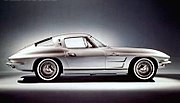
1963 Corvette Sting Ray Coupe
-
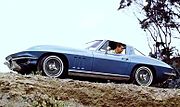
1965 Corvette Sting Ray Coupe
-
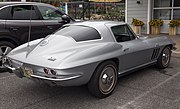
1966 Corvette Sting Ray Coupe
-

1967 Corvette Sting Ray Coupe
Z06 [edit]
Duntov first conceived of the Z06 in 1962. Despite GM's ongoing support of the AMA ban on factory racing involvement, Duntov knew that individual customers would continue to race Corvettes, so during the planning of the Sting Ray projection he suggested that it would be a skillful idea to proceed with parts development in order to do good racers, and as a way of surreptitiously circumventing the racing ban. When GM management eventually withdrew their support of the ban, Duntov and his colleagues created "RPO Z06" as a special performance equipment bundle for the Corvette. The Regular Product Selection (RPO) was a GM internal ordering code designation. The packet was specifically designed for competition-minded buyers, so they could order a race-ready Corvette straight from the factory with just i bank check of an pick box. Previously, the optional racing parts were literally hidden in the order course and then that simply the nigh knowledgeable and perceptive customers could find them. The Z06 package was first offered on the 1963 Corvette, and included:[30]
- Front anti-roll bar with a 20% larger diameter
- Vacuum brake booster
- Dual master cylinder
- Sintered-metal brake linings
- Power-assisted Al-Fin drums cooled past forepart air scoops and vented backing plates
- Larger diameter shocks and springs — nearly twice every bit stiff as those on the standard Corvette
These Corvettes came to be known as "Big Tanks" because the package initially replaced the 20 US gal (76 l; 17 imp gal) gas tank with a 36.5 US gal (138 fifty; 30 imp gal) tank for races such every bit Sebring and Daytona. At commencement the package was available only on coupes, as the oversized tank would not fit in the convertible, although the rest of the Z06 option packet was later fabricated available on convertibles likewise.
Thus, the 1963 Corvette was technically the first Corvette that could be designated every bit "Z06." The only engine option on the Z06 was the L84 327 cu in (5.iv L) engine using Rochester fuel injection. With factory exhaust manifolds, required to run the cars in the SCCA production classes, Chevrolet rated the engine at 360 hp (268 kW). The Z06 pick cost an additional $1,818.45 over the base coupe cost of $four,252. Chevrolet later lowered the package price and eliminated the larger gas tank from the Z06 package, though it remained available as an addition pick for any coupe. All told, Chevrolet produced 199 of these "original" Z06s.[31]
One thousand Sport [edit]

1963 Chevrolet Corvette Grand Sport raced past Bob Bondurant
In 1962 Duntov initiated a program to produce a lightweight version based on a image that mirrored the new 1963 Corvette.[32] Concerned about Ford and the Shelby Cobra, Duntov'southward plan included plans to build 125 examples of the Corvette Thousand Sport to let the model to be homologated for international Grand Touring races. After the GM executives learned of the hugger-mugger projection, the plan was stopped, and only five cars were built. All five cars have survived and are in individual collections. They are among the near coveted and valuable Corvettes ever built, not because of what they achieved, but because of what might have been.[33]
The cars were driven by famed contemporary race drivers such as Roger Penske, A. J. Foyt, Jim Hall, and Dick Guldstrand amongst others. Dick Thompson was the commencement driver to win a race in the Grand Sport. He won a 1963 Sports Car Club of America race at Watkins Glen on August 24, 1963, driving Grand Sport 004.[34]
Chassis #001 is owned by former banker and motorcar collector Harry Yeaggy of Cincinnati, Ohio. It was purchased for $4.2 million in 2002.[35]
Chassis 002 is a function of the permanent drove at the Simeone Foundation Automotive Museum in Philadelphia, Pennsylvania. The car is in running status, and is the only One thousand Sport body which is original and unrestored. Also on display are a replica body and a spare 377 cubic inch engine, which were commissioned by the car's previous possessor, Jim Jaeger, for participation in vintage racing without damaging the original components.[36]
Chassis #003 is owned by car collector Larry Bowman. Information technology was bought in 2004 for an undisclosed sum.[37]
Chassis #004 is part of the Miles Collier Collection on brandish at The Revs Institute in Naples, Florida. This chassis was used in the Rolex Monterrey Motorsport Reunion in 2013.[38]
Chassis #005 is in the individual drove of Nib Tower of Institute City, Florida. He was a old Corvette development engineer and besides owns several historically significant Corvettes in his drove.[39]
The Corvette Grand Sports were raced with several dissimilar engines, simply the almost serious factory engine actually used was a 377 cubic inch displacement, all-aluminum, small block with 4 Weber side-draft carburetors and a cross-ram intake, rated 550 hp (410 kW) at 6400 rpm. Body panels were made of thinner fiberglass to reduce weight and the inner body structure 'birdcage' was aluminum rather than steel. The ladder-type frame utilized large seamless steel tubular side members connected front end and rear with crossmembers of about the same diameter tubes. Another crossmember was just aft of the manual and a 4th one at the rear kick-up anchored the integral roll cage. The frame was slightly stiffer than the 1963 Corvette production frame and was 94 lb (43 kg) lighter. A number of other lightweight components were utilized to reduce overall weight to about 800 pounds less than the product coupe.[32] Initially the Thousand Sport project was known merely every bit "The Lightweight".[twoscore]
-

Corvette Grand Sport #001
-

Corvette Thou Sport #002
-

Corvette Grand Sport #003
-

Corvette Grand Sport #004
-

Corvette Grand Sport #005
Concept car [edit]

The Pininfarina-bodied Corvette Rondine
The 1963 Corvette Rondine (Ron-di-nay, Italian for Swallow) is a concept car based on a 1963 C2 chassis that was built for the 1963 Paris Auto Evidence. Information technology was designed by Tom Tjaarda of Pininfarina.[41] [42] It was sold at Barrett-Jackson 2008 for one.6 meg dollars.[43]
See besides [edit]
- Corvette Stingray (concept car)
- Mako Shark (concept auto)
- Chevrolet Engineering Inquiry Vehicle
- Zora Arkus-Duntov
- Bill Thomas Cheetah, a 1963 individual-venture Shelby Cobra rival, whose drivetrain was generally sourced from the C2 Corvette
References [edit]
Notes [edit]
- ^ "Enter To Win a 1963 Corvette Sting Ray "Fuelie" and a 2017 Lingenfelter Signature Edition Corvette!". www.lingenfelter.com. 3 April 2017.
- ^ "1967 Corvette Condensed Historical Facts". www.proteamcorvette.com. 1 May 2007.
- ^ Teeters, K. Scott (30 March 2012). "A Look Dorsum At Corvettes Designed by Larry Shinoda". www.corvettereport.com.
- ^ Perkins, Chris (28 September 2016). "The Aforementioned Guy Helped Design Both of These Cars". Road & Track.
- ^ Szymkowski, Sean (29 September 2016). "The C2 Corvette Sting Ray And Porsche 928 Share A Common Designer". GM Authority.
- ^ "Duntov Motor Visitor - Operation Corvette Parts". Duntovmotors.com. Retrieved 2010-10-05 .
- ^ "Superformance Corvette Thou Sport". www.superformance.com. 12 August 2019.
- ^ "Chevrolet — 1963 Corvette Specifications" (PDF). GM Heritage Center.
- ^ Corvette 50th Anniversary by the Editors of Consumer Guide
- ^ a b The Editors of Consumer Guide
- ^ Brock 2013, p. 42–45, 101–105.
- ^ Bail, John R. (October 1962). "The 1963 Corvette - A technical analysis". Road & Track.
- ^ Rudeen, Kenneth (ane October 1962). "A Detroit challenge to the best from Europe". Sports Illustrated. pp. 58–60.
- ^ Flory 2004, p. 203.
- ^ a b c Antonick 1999.
- ^ a b c d due east Corvette 50th Anniversary
- ^ "Riverside three Hours". Racing Sports Cars. Retrieved 16 September 2016.
- ^ a b Gillogy, Brandan (x September 2015). "Mickey Thompson Z06 Mystery Motor Stingray". Hot Rod Network. Retrieved 16 September 2016.
- ^ Kimble, David (Dec 2015). "427 Mystery Motor Corvettes". Hot Rod. TEN: The Enthusiast Network Magazines, LLC.
- ^ "Daytona 250 Miles - American Challenge Cup". www.racingsportscars.com.
- ^ Super Street Cars, nine/81, p.35.
- ^ a b Hot Rod Magazine's Street Machines and Bracket Racing #5 (Peterson Publishing, 1981), p.77.
- ^ "1965 Corvette Specs". world wide web.corvettemuseum.org.
- ^ "65/66 Single/Dual Master Cylinder? - CorvetteForum - Chevrolet Corvette Forum Give-and-take". www.corvetteforum.com.
- ^ Potrebić, Nikola (26 Oct 2019). "The True HP of the 10 Nearly Powerful Classic Era Muscle Cars". autowise.com.
- ^ Koscs, Jim (13 Baronial 2013). "Muscle Motorcar Horsepower – How Exaggerated Was Information technology?". www.hagerty.com.
- ^ 1966 Corvette Brochure
- ^ "1967 Chevrolet Corvette 427 L71, 1968 MY 19400". www.carfolio.com.
- ^ 1967 Corvette Brochure
- ^ Staff, GM (2000). 2001 Specialist's Data Book Corvette. Michigan: Gail & Rice Productions, Inc. p. 48.
- ^ Lachenauer, Scotty (four September 2019). "The Big-Tank 1963 Chevrolet Corvette Z06 Is 1 of the Rarest American Cars Ever". www.automobilemag.com.
- ^ a b Friedman and Paddock 1989, p. 16.
- ^ Yates, Brock (April 1967). "Chiliad Sport!". Machine and Driver. Vol. 12, no. 10. New York, New York: Ziff-Davis Publishing Company. pp. 48–52.
- ^ Friedman and Paddock 1989, p. 36.
- ^ "The Twenty-four hour period the Corvette Thou Sports Stomped the Cobras". Super Chevy.
- ^ Simeone, Frederick. "1963 Chevrolet Corvette Grand Sport". Simeone Foundation Automotive Museum. Retrieved ten March 2015.
- ^ "Untold Stories of the 1963 Chevrolet Corvette Thousand Sport #003". Super Chevy.
- ^ "1963 Chevrolet Corvette Grand Sport". Revs Constitute . Retrieved 2019-08-02 .
- ^ "Bill Belfry's Career every bit a Corvette Development Engineer". Super Chevy.
- ^ "The Lightweight". Archived from the original on 22 Baronial 2015. Retrieved 26 Dec 2019.
- ^ Melissen, Wouter (21 January 2008). "Chevrolet Corvette Rondine Pininfarina Coupe". www.ultimatecarpage.com . Retrieved 2010-10-05 .
- ^ McKeegan, Noel (29 October 2007). "One-off Pininfarina-Bodied 1963 Corvette 'Rondine' Concept up for auction". www.gizmag.com.
- ^ "Lot #1304 1963 CHEVROLET CORVETTE COUPE "RONDINE" CONCEPT CAR". world wide web.barrett-jackson.com.
Bibliography [edit]
- Brock, Peter Corvette Sting Ray — Genesis of an American Icon. Henderson, NV: Brock Racing Enterprises LLC, 2013. ISBN 978-0-9895372-1-vi.
- Flory, J. "Kelly", Jr. American Cars 1960–1972. Jefferson, NC: McFarland & Coy, 2004. ISBN 978-0786412730.
- Antonick, Mike. "Corvette Black Book 1953–2000". Powell, Ohio: Michael Bruce Assembly, Inc., 1999. ISBN 0933534469.
- Friedman, Dave and Paddock, Lowell C. Corvette Grand Sport: Photographic Race Log of the Magnificent Chevrolet Corvette Manufacturing plant Specials 1962–1967. St. Paul, Minnesota: MBI Publishing Co., 1989. ISBN 0-87938-382-viii.
- Holmes, Marker (2007). Ultimate Convertibles: Roofless Beauty. London: Kandour. pp. 54–59. ISBN978-ane-905741-62-5. .
- Mueller, Mike. Corvette Milestones. St. Paul, Minnesota: MBI Publishing Co., 1996. ISBN 0-7603-0095-10.
- Nichols, Richard. Corvette: 1953 to the Present. London: Bison Books, 1985. ISBN 0-86124-218-1.
External links [edit]
- 1963 Corvette - C2 Corvette history and technical development
- 1963 Corvette Grand Sport - Detailed history and images of the Grand Sport Corvette
- 1965 Corvette convertible - 1965 Corvette convertible
Source: https://en.wikipedia.org/wiki/Chevrolet_Corvette_%28C2%29
0 Response to "Is Art Morrison Frmae and Solid Rear Ened Better Than Rear Corvette Supension on C2"
Post a Comment